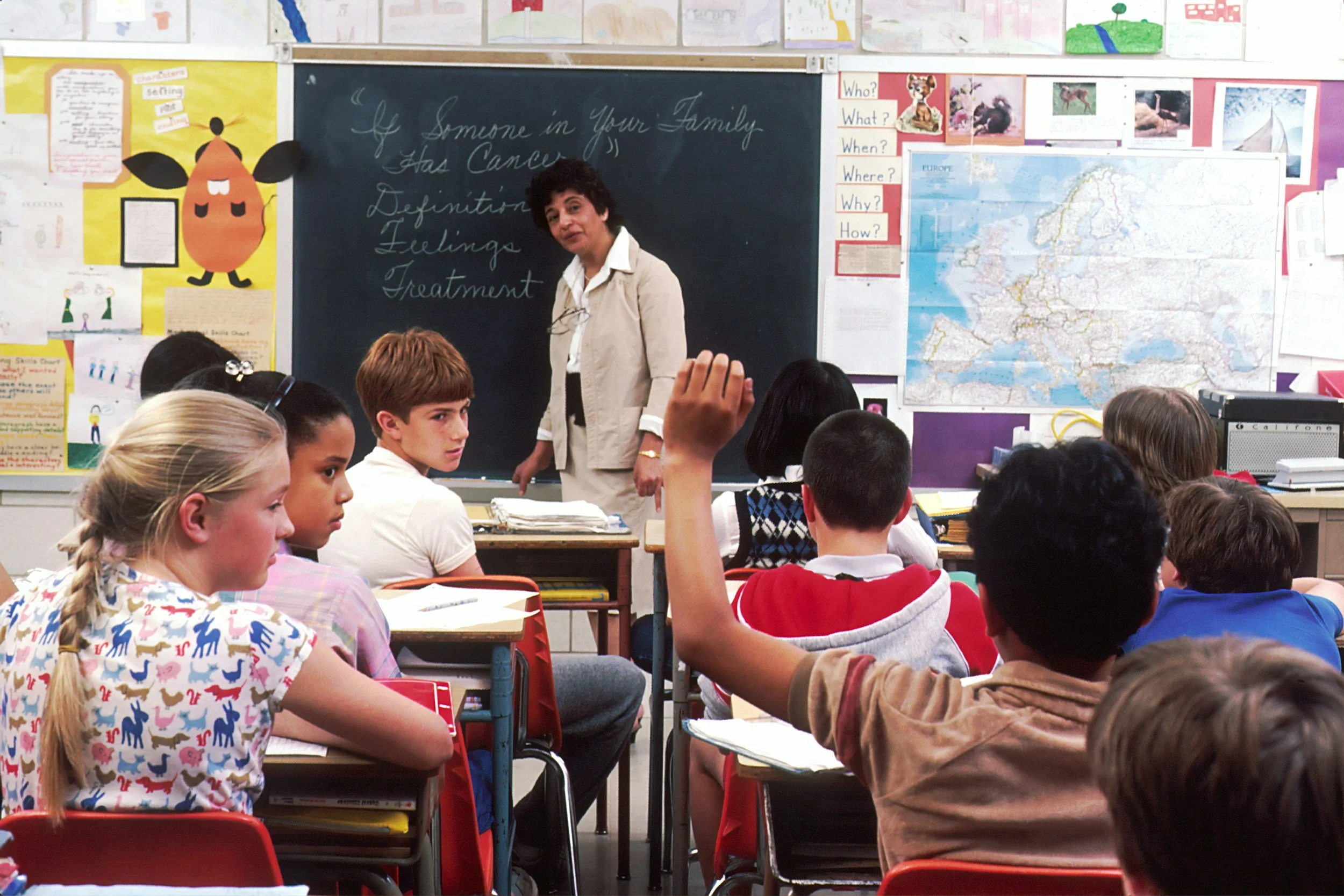
Oracy in schools: I couldn’t find a free stock image of British schoolchildren speaking in class, but you get the idea
Talking in class: government puts extra focus on confident speaking for kids
Read on for ideas and advice for grownups who might have missed out… we know that speaking skills are vital for success in professional life
Back in August I wrote about Danish schools making teenagers orally defend their essays to catch out AI cheating. My take on it is that it isn't a radical innovation; from the Roman ‘viva’ to the oral tradition of the ancient Greeks and Socrates, speaking has always been a vital part of Western education.
Now state schools in the United Kingdom - where I’m based - are going to devote extra time and resources to helping children to practise oracy and spoken languages skills; what we normal people outside the world of education policymaking usually call ‘talking’.
The Education Secretary, Lucy Powell, has written in The Guardian that spoken communication is "not a soft skill or a bolt on", and the government has confirmed that the new National Curriculum will carry higher expectations on oracy and confident speaking, alongside reading and numeracy, especially for young adolescents at the beginning of secondary school.
I am delighted! (Full disclosure, if it wasn’t already obvious: I earn my living helping people to be better speakers, so you can take my enthusiasm with a pinch of salt. Really, I should be worried: if the next generation learn effective communication skills at school, there will be no work for me to do in 20 years’ time! But no, of course I'm cheering).
One big difference, though, from the Danish policy - that uses speaking as a test. The Labour government in the UK is proposing that speaking as a skill will be taught more widely and fully.
And, sadly, most of the adults I work with can’t relate all that well to either. Because nobody tested them on or taught them to improve their speaking skills.
The ‘soft’ skill nobody put on your timetable

The art of conversation: my clients report that it’s very common these days for business presentations to be informal chats
Oracy is an awkward word,, but put simply, it's the ability to talk and listen: to say what you mean, in a way people can follow, and to hear, think and respond in the moment.
In most people’s experience, once they’re out of nappies and they’ve mastered ‘mama’ and ‘dada’, speaking is something we learn ‘naturally’.
Some people get their practice in at home, in families where the dinner table is a debating chamber.
Some get it at school, in debating societies or at institutions that treat public speaking as part of the package: ie. private schools. Powell makes exactly this point: private schools don't leave confident communication to chance, and parents paying the fees would soon complain if they did.
The Sutton Trust has found the same pattern from the other direction: private school pupils are more likely to have opportunities outside school to develop confident speaking.
The independent Oracy Commission, chaired by Geoff Barton, published a report at the end of 2024 which argued that oracy should be the "fourth R" of education, equal in status to reading, writing and arithmetic. It warned that the focus on reading and writing had downgraded spoken language in the curriculum.
So if you're a capable professional who goes quiet in meetings, rehearses a sentence four times before saying it, or the ideas that are clear and compelling in your head come out as word salad , you haven't failed. You probably weren’t taught it.
Ask Socrates: speaking helps you work out what you know.

‘Living speech’: Socrates believed that the written word was ‘dead’ and that learning could only take place through talk [Image: Kristian Zahrtmann, Socrates and Alcibiades (1911)]
There’s some fascinating discussions of speaking/listening versus writing/reading in Maryanne Wolf’s book, Proust and the Squid: The Stong and Science of the Reading Brain.
Part of the story she tells about that world-changing ancient Greek invention, the alphabet, is how the famous philosopher and teacher Socrates objected strongly to this new(ish) thing called writing.
Ancient Greece was very much an oral culture. Educated people were expected to memorise hundreds of lines of poetry, in order to truly ‘know’ it. Socrates, of course, is famous for his dialogue-based way of educating and learning, through questioning and discussion.
Wolf recounts how he believed that ‘oral and written words play very different roles in an individual’s intellectual life… writing demands less of memory and internalising knowledge….’ and there was 'a ‘unique role for oral language in the development of morality and virture in society’.
In other words, Socrates thought reading made young people intellectually lazy, and that it wasn’t possible to truly understand ideas if you only read about them, instead of talking about them. He thought you couldn’t truly be good, unless you spoke about goodness.
Socrates believed that you could really learn to think, without speaking.
One line from my August post is worth repeating: speaking isn't just a way of expressing what you already know. It's how you find out what you know.
Don’t just take Socrates’ word for it. There's good evidence behind that. Lucy Powell cites the Education Endowment Foundation, which identifies oral language approaches as among the most effective interventions in schools, worth around six months of extra progress in primary and five in secondary.
She also points to Geoff Barton's observation that in Japan, Singapore and the Netherlands, pupils are expected to explain their reasoning aloud, even in maths.
Far from lowering standards, that makes them better mathematicians.
But every week I see competent, clued-up adults, who struggle with speaking about what they know.
The lawyers, surgeons, software engineers and management consultants I coach are superb at reading, thinking and writing. They can spend hours refining an email or a report (or the use an AI like Claude to help them).
But writing lets you pause, review and rewrite.
Speaking and listening happen at the same time, in real time, and often with the listener watching your face and gestures, picking up information and nuance there too.
And of course, now that AI can polish the written part for us, there comes a moment when you have to speak - and there’s nowhere to hide.
You've been promoted. You're leading a team or talking to clients. Someone asks a question in a meeting… and something is missing.
Business leaders know this. Polling for the Oracy Commission found that 80 per cent of business leaders supported spending more time on spoken language and listening in schools. Powell cites a Chartered Management Institute survey in which managers flagged communication gaps in workplace readiness.
Employers can see the problem. But they rarely offer a way to fix it for the people already on the payroll.
Not everyone is convinced (and that's useful)
It isn't an uncontroversial policy. Powell notes that critics have called the proposals "dumbing down". One commentary piece went further and called the plans "meaningless". A Tes article makes a subtler point: more opportunities to talk are not enough, and the push has to be inclusive by design, so that pupils with communication needs aren't left behind.
I think that last point is the important one, and it applies far beyond the classroom. Being given the chance to talk is not the same as being taught how. Plenty of my clients talk all day. They still feel unheard, and they still feel that are somehow letting themselves down.
Oracy and accent reduction
Of course a lot of this discourse is focused on school and learning environments, for what are presumed to be native English speakers. Nobody is talking about accent, pronunciation or speaking English as a second language.
Most of my clients are leaders and professionals whose first language is Russian, Chinese, French, Spanish, Polish, Italian, Urdu… Their English is excellent. Their grammar is often better than mine. Yet they tell me the same things:
I know what I want to say, but it comes out less well than it sounds in my head.
I avoid certain words because I'm worried people won’t understand or they’ll make me sound foolish.
People ask me to repeat myself, and it’s embarrassing to have to repeat myself three times.
That is not a language-proficiency problem. It's a speaking-skills problem, and speaking skills, like any skills, can be trained.
Two things to think about
Do you trail off…? Speak with a bit more ‘oomph’. Many of us trail off towards the ends of… y’know, um, thoughts…. Aaaaanyway…
The energy fades away. Treat a thought like a physical object that you are placing firmly in the listener’s hand. (I’ve written about vocal energy, and how to use it, here.)
Pause AFTER an important point. You don’t need to pause before a key point: ‘and the winner is….’ That’s pausing ‘for effect’ . But half a second’s pause, after you share a thought, might feel enormous and self-indulgent to you but it gives listeners time for what you’ve said to sink in (More on that in the power of pauses.)
If you'd like to see how speaking differs from presenting, I've also written about the difference between "speaking" and "presenting".
Questions people ask
What is oracy? Oracy is the ability to express yourself clearly in speech and to listen and respond well. It covers voice and delivery, word choice, structuring your thinking and interacting with other people.
Can adults really improve their speaking confidence and accent? Yes. Adults often progress faster than children because they have clear goals and know which situations matter. Targeted practice with feedback is what makes the difference.
Do I need to lose my accent to be taken seriously? No. The aim is clarity, not sounding flawlessly British, or ‘posh’, or if you have a regional British accent, ‘southern’. Most people need to adjust a small number of sounds and rhythm patterns, not abandon their identity.
Why does the government want children to speak confidently? The government says confident speaking is a core skill for school, work and life, and that it shouldn't depend on a family's income or the school a child attends. It is building higher expectations for oracy into the new National Curriculum.
If you'd like to try this yourself
The government is finally taking speaking seriously for the next generation. You don't have to wait for them to catch up.
If you recognise yourself here (brilliant on paper, less sure in the room, or fluent in English but tired of being asked to repeat yourself), I'd love to hear about it. Message me and we'll talk it over in my free one-hour online taster session. There's no pressure and no hard sell. We'll listen to how you sound now, identify the specific habits holding you back, and try a few techniques so you can feel the difference.
Alternatively, you can work with Sophie, Nathalie or Sonya, who are all first-rate accent and pronunciation coaches with their own particular specialisms (Sophie and Nathalie are both trilingual in English, French and Russian). You'll be in very good hands!