The AI Cheating Fix Schools Just Discovered? It's 2,000 Years Old
Why Public Speaking and Oral Communication Matter in the Age of AI
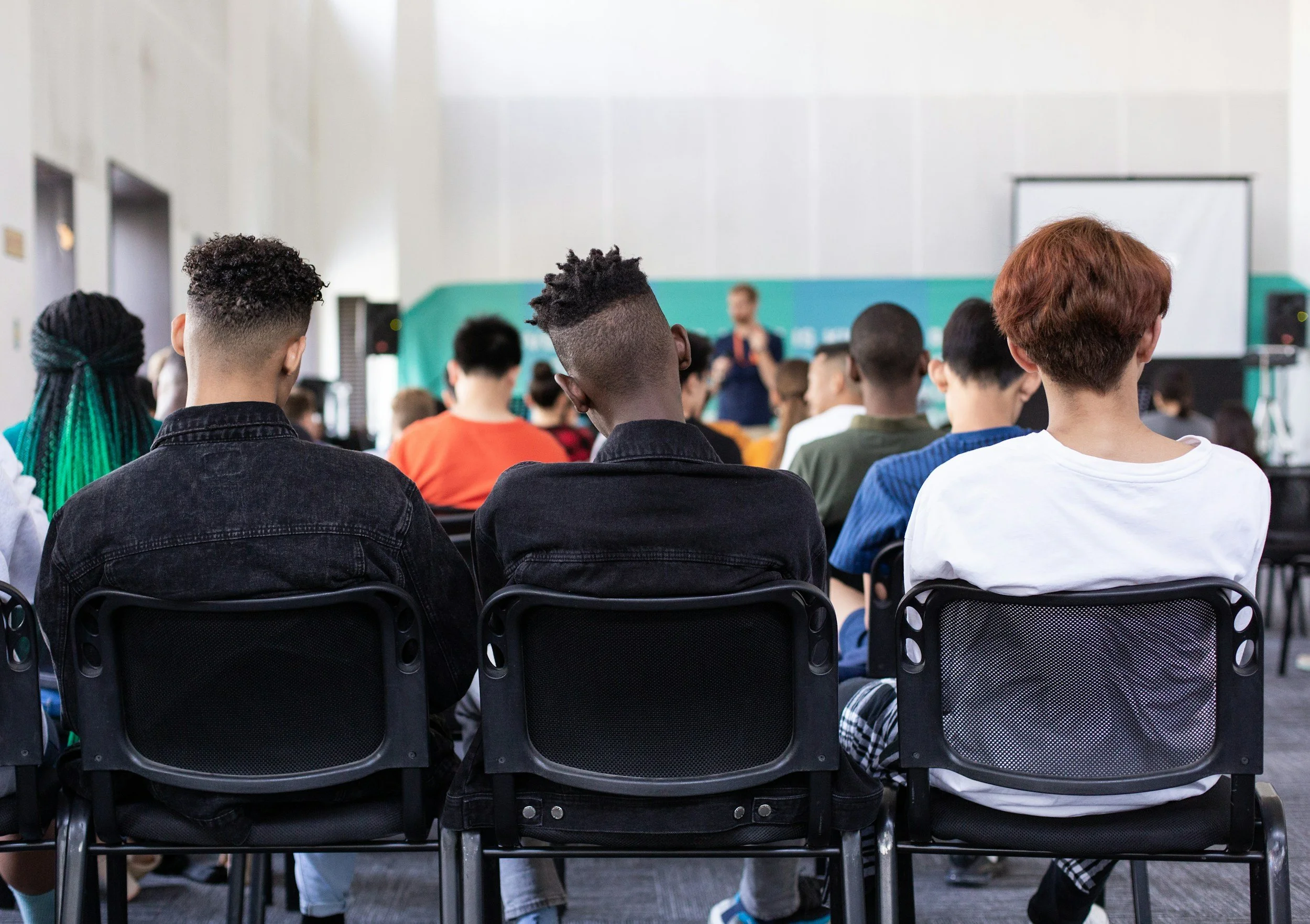
AI cheating: these guys are pretending to listen while slyly asking ChatGPT for the answers
I came across an article in The Guardian last week about how Danish schools will soon require 16- to 19-year-olds to “orally defend” their written essays in class, as a way of combating AI-assisted cheating.
My first thought was that this is fantastic news.
I'm absolutely fascinated by the spoken word – call it public speaking, presenting, oracy, whatever – and I cheer on any measure that encourages people to do more of it.
(And I earn my living from helping people get better at it, so the more people take public speaking seriously, the more likely I am to be able to pay my rent. Full disclosure)
I had to smile, though, at the way this was reported as some kind of radical innovation, prompted by the unprecedented threat to traditional classroom education posed by AI.
It's a viva.
The viva isn't new

Viva voce: talking about your thesis with subject experts is not intimidating at all
If you or someone you know has studied for a PhD, you'll know about the viva voce, Latin for “living voice”.
You spend years working on your doctoral thesis, then after you finally submit it, the next part of the assessment process is being interviewed, face to face, by examiners who expect you to “orally defend” your research.
AI-written essays are new, but the viva has been a staple feature of Western education for centuries.
It is a way of finding out whether someone genuinely understands what they have written, rather than simply whether they can produce an impressive piece of text.
A thesis? Anybody could have written that. Prove that you wrote it: speak about it, answer questions about it, defend your ideas.
And the spirit of the viva is about more than preventing plagiarism. Testing your ideas and assertions through speech and debate, through listening as well as speaking, is one of the foundations of intellectual life. It is as crucial an exercise of intelligence as reading and writing.
What Oxford taught me about speaking and thinking

Oxford University: also not intimidating at all
I don't have a doctorate, but I did study at an institution with a strong tradition of learning through the “living voice”: the University of Oxford.
Applying to read English, like I did, starts with submitting essays to showcase your written work. If the admissions tutors are impressed by those samples, they invite prospective students to an interview.
These interviews happen online now, but when I was a teenager, I had to travel to Oxford, sit in a tutor's book-lined study opposite not fewer than FOUR faculty members, and have a discussion about my essays and the study of literature in general.
At the time, it was incredibly intimidating: a group of Oxford dons chatting with 18-year-old me about my thoughts on T. S. Eliot.
It was good preparation for undergraduate teaching at Oxford, which was delivered largely through the weekly tutorial: an hour-long conversation between a tutor and, at most, two students, about the essay you'd written that week.
But the tutors didn't read the essay. They listened to it.
We had to read our essays out loud, and when we'd finished, the discussion would begin.
I used to find this physical act of reading aloud incredibly difficult. I felt so tense that I could barely catch my breath; for the five to ten minutes it took to read, it was like I was in the sea up to my neck, frantically treading water, on the brink of drowning.
I look back on it fondly, though. Many years and a lot of voice coaching and experience later, speaking is my life.
More importantly, I look back on it fondly because I was lucky to have that experience. So much time and attention was given to learning through speaking and listening, not just reading and writing.
The practice of speaking my thoughts out loud, and then seeing how they stood up to the scrutiny of other minds in the moment, shaped my mind and developed my understanding of how to explore ideas and participate in thoughtful debate and discussion.
It educated me.
Samuel Johnson and the intellectual value of conversation

A writer I discovered at university, the great 18th-century essayist Samuel Johnson, wrote about how a true “man of letters” could come unstuck if he concentrated on reading and writing but didn't engage in spoken debate.
Johnson warned that someone who works and writes alone may “look only after such arguments as tend to his confirmation”. When he eventually encounters people who have reached different conclusions on the same subject, it’s a shock, and it’s hard to process: “his surprise impedes his natural powers of reasoning”.
You can read the full essay here.
Johnson's point was that thoughtful people need to get out of the echo chamber of solitary study and test their ideas among people with different ideas. Through the unpredictable nature of conversation and debate, we develop the mental agility to defend our thinking, discover its weaknesses and, sometimes, change our minds.
We're speaking less, not just at school
Speaking and writing are different communication skills
This is the wider issue that interests me much more than whether a student used an AI app to write an essay.
Young people increasingly do much of their social interaction through screens: texting, messaging, reading captions and watching social media videos. They take in a huge amount through text, but get fewer opportunities for real-time speaking, listening and discussion.
And we're speaking less in other areas of life, too. A recent article in The Atlantic highlighted a study which found that, on average, people spoke about 28% fewer words per day in 2019 than they did in 2005.
How often do you call your friends for a chat? You text them, right?
I see the consequences of this in my work. I coach lawyers, surgeons, software engineers and management consultants who are extremely good at reading, thinking and composing written responses. They may spend hours refining an email, report or presentation.
But writing and speaking are very different forms of communication. When you write, you can take your time, review what you've written, rewrite it and work out exactly how you want to express yourself. Speaking and listening happen at the same time, so there is much more pressure to think and respond in real time.
And now we have AI to help us with the written part.

Chatbots: loved by young people who are scared of doing homework and talking to strangers
Grammarly, ChatGPT, Claude and other tools can draft and polish an email, report or presentation, even a reply to a new match on a dating app. They can help turn a mediocre writer into a polished one.
But eventually there comes a point where you have to speak.
Maybe you've been promoted and are now leading a team or talking to clients, whereas before you could quietly get on with the text-based, largely non-verbal work that you're extremely good at. Suddenly you're answering questions in a meeting, presenting to a room full of people or being put on the spot during a town hall.
There's nowhere to hide.
AI is making speaking more important
Public speaking skills matter in the workplace, now more than ever
Which brings us back to the Danish school system.
Requiring students to orally defend their essays is an obvious way of checking whether they genuinely understand what they've submitted. But it also does something more valuable: it gives students an opportunity to practise the skills of oral communication, public speaking, listening, discussion and thinking on their feet.
That’s the really exciting bit.
Speaking isn't simply a way of expressing what you already know. Speaking helps you work out what you know.
That is why I think the rise of AI makes strong verbal communication skills more important. If technology can increasingly help us produce polished written communication (like this blog article… haha!) our ability to explain, discuss, question and defend our ideas in real time becomes one of the clearest ways to demonstrate what we actually understand.
So if you recognise your own situation in any of this – and of course I'm not suggesting you use AI to cheat on your secondary-school essay assignments! Perish the thought! – and you feel that your public speaking and oral communication skills don't reflect your intellectual ability and your written communication skills, I'd love to hear about your experience.
Message me and let's talk it over during my free one-hour online taster session.