Atomic Habits for Accent Reduction: Build Better Speaking Habits That Actually Stick
How the principles of James Clear’s bestselling book are woven into my coaching on accent reduction and public speaking
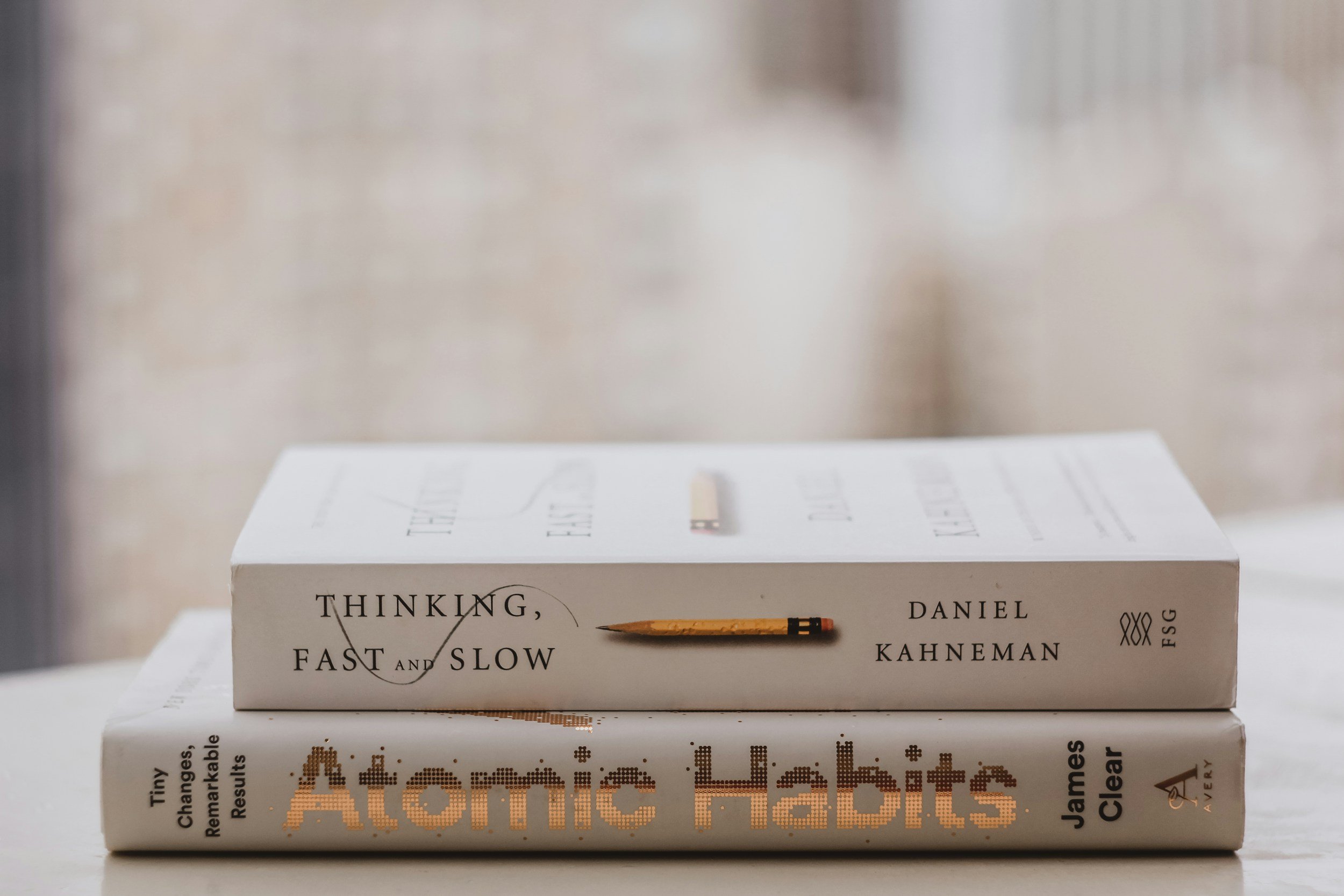
Atomic Habits for accent reduction: now I just have to figure out how to steal clicks for Thinking Fast and Slow
I'm trying to get back into the habit of reading books. (By the way, read this one that my friend Graham Allcott wrote).
Anyway, I started by reading that famous book about habits.
Atomic Habits by James Clear came out in 2018 and has sold 20+m copies around the world.
It's an easy read, less than 300 pages. And as I discovered in the book, one of the Clear's Laws on successfully adopting habits is to 'make it easy'.
That's the start of a good reading habit, right?
I was also interested in it because my work as an accent reduction and public speaking coach is all about habits.
Helping people to form good habits, and let go of unwanted habits, when it comes to their speaking.
I wanted to see how my coaching practices measure up against the teaching of the bestselling expert on habits.
I'm pleased (and relieved!) to find that there's a lot of overlap between James Clear's thinking, and the methods I use in my coaching to get speakers into new and better habits.
Accent reduction and Atomic Habits: getting a little better every day
What are your existing speech habits?
In an early chapter, Clear talks about how behaviour change starts with awareness. You need to notice exactly what you're doing, or not doing, what your current habits are, before can create the conditions in which a new habit can take root.
“behaviour change starts with awareness. ”
I agree: that's why we have the free 1hr taster session, that I offer to all potential clients.
In this session, I have a really close listen to you, and all the pronunciation habits that make up your accent: that's all an accent is. A set of habits, a set of shapes you make with your lips, tongue and jaw. If you want to sound different, you first need to understand why you sound the way you do now. Accents aren't 'natural', we're not born with any accent. WE learn it.
So if we want to have a different accent, we look in detail at the habits that make up the new accent, and work on acquiring those habits.
Building lasting speech habits: little and often
The foundations of James Clear's thinking on habits, and the 'atomic' bit of the title, is about small incremental improvements, one 'atom' at a time.
Taking even a small step, doing one press-up, reading one page, is the start of a habit that can be built on. And small gains add up over time.
This is exactly the approach I take when it comes to accent reduction: I recommend - actually I insist on - only 1 to 2 minutes of practice a day.
In a typical accent reduction session with me, we work in detail on one sound: for example, the 'o' sound in 'pop'.
NOTE: every course is tailored to the individual, and over ten or five sessions, we're aiming for better, not perfect - we only cover the sounds that will make the biggest overall difference to the clarity of your English pronunciation
Then, every day for the next couple of weeks, the client's job is to practise that sound for just 1 to 2 minutes.
Repeat the sound several times: 'o'.
Choose a simple word, and repeat several times: 'pop'.
Choose a simple thought (thought = a short string of words): 'pop to the shop'. Repeat several times.
Just that small amount of focused practice, of the physical action of moving your jaw, lips, and tongue to form that 'o' sound, is enough to build a lasting habit.
And here's the important bit: you practise, and focus, for just those 2 minutes a day. And then the rest of the day, when you're speaking: forget about your accent, pronunciation, 'sounding more English', and put your focus where it needs to be: on the person or people listening to you.
1 to 2 minutes is about the time it's taken you to read this far into the article.
Can you spare that much space in your busy daily life to build a new habit?
(of course you can. You made time to read this article, didn't you?)
Clear goes on to talk about how you build a habit through repetition, until the behaviour becomes automatic.

Doing my best: some fatuous stock imagery to break up the text. Please continue reading….
Four 'Laws' of Habit-Forming, and How My Accent Reduction Coaching Obeys All of Them!
The Four Laws of building 'Atomic Habits' are pretty simple. To form a new and lasting habit, a person needs to:
Accent reduction, Atomic-Habits-style, step 1: make it OBVIOUS
When are you going to do your 1-2 minutes' sound-practice? You need to decide.
'Atomic Habits' covers 'habit-stacking': add your new habit to an existing habit.
For example, I recommend doing your sounds-practice in the bathroom mirror every morning, when you brush your teeth (not literally while you're brushing your teeth though haha)
You're at the mirror anyway, and it helps to use a mirror to practise so you can see what shape your mouth is meant to be making. It's the perfect time.
Step 2: make it ATTRACTIVE
On the other hand, I don't demand that you practise in the mirror.
Sometimes, the sheer weirdness of seeing your mouth make an unfamiliar shape, and then hearing a different vowel sound come out of it, can be off-putting and a bit scary.
Especially if you think someone in the next room might overhear you and laugh at you. (I think when clients fail to practise daily, this is why. 'What if somebody hears??')
In your car, on the loo - it doesn't matter where you do it, but if you don't do the practice, it will take longer to make progress.
The other thing that makes it more appealing (I think) is that I don't demand that you use set words and phrases.
There's no 'the rain in Spain falls mainly on the plain'. Unless you just want me to tell you what to say!
But I encourage clients to use their ears. The sounds of 'BBC' or Standard Southern British English are all around you, either IRL if you're based in the UK, or online on social media, podcasts and BBC Sounds if you're anywhere else in the world.
I encourage people to practise with words they hear, words they might actually use.
So when we practise the short 'a' vowel as in 'cat', I don't say 'say 'cat''. I say, 'what words can you think of that have this 'a' sound in them?'
One of my favourites is 'absolutely'. When you strongly agree, think about all the 'oomph' you can put into that word when you open your mouth wide for the 'a' of A-bsolutely!'
The closer to your real speech we are, the less weird it should feel to make changes to how you sound, and the more comfortable you'll be with these new speech habits.
Step 3: make it EASY
I refer you to the above: it's only 2 minutes a day. Easy, right?
Well, to make it even easier, I have a bit of tech to help you stay on track.
Each client has her own account on my web portal, which is designed to support coaching relationships like ours.
I can set it up to help you track your new habit, with a daily email reminder to do your 2 minutes' practice, and log it on the system with just a click.
Then we have the joint satisfaction of looking back over days and weeks and seeing how consistent you are - and if you're struggling for consistency, we can adjust and get back on track.
Atomic Habits tells you to 'prime your environment', so you have an icon on your phone's homescreen to take you straigh to your coaching account. You can sync your calendar with it, so all the assignments, reminders and appointments with me are right there in your hand.
I mean… I don't want it to feel like I've moved in with you :) You''ve got a lot of other stuff going on in your life. But I aim to make it easy to make this work fit in and become part of your life.
Step 4: make it SATISFYING
Ok, so you're doing the practice. Well done. So what?
Everyone likes a bit of feedback. Especially if you're not totally sure you're doing the right thing.
I think one of the big advantages of investing in accent reduction and public speaking coaching, rather than paying a couple of pounds for an online course or a video series, is the relationship.
I like to check in on clients and hear how they're getting on. I like to give feedback and encouragement.
So part of a typical course of 10 one-hour sessions is that I ask clients to send me voicenotes of their practice, up to a couple of times a week (if I had the capacity to listen to everyone's daily 2 minutes, I would, but I only have two ears).
I'll listen to your voicenote and then reply via voicenote, giving praise when you're nailing it, and pointing out where the new sound is going missing and you're falling back into old familiar habits. I always invite clients to listen again to their voicenotes to see if they can hear what I'm hearing.
I'm always upbeat about feedback, because what's the point of being downbeat and chastising you for your mistakes? You're a grownup, we're not at school, and I don't judge anybody for finding it hard, or for not putting in the work.
It's all part of making it SATISFYING :)
Because ultimately, making significant changes to your speaking habits is a mid- to long-term project. You may be happy with your progress after ten sessions, and find a sound that you settle into from then on. Or you may need more time to keep practising. And if you don't have the time, or budget, to work with me in that long-term timeframe (some do - I love my longstanding regulars!) you'll be continuing to work and build your new habits, under your own supervision. So you'll need to train your own ear to those distinctive features of your target sound, and adjust as necessary.
Becoming the sort of person you want to be
There's an interesting chapter near the start of Atomic Habits where Clear talks about behaviour change being a matter of identity; becoming the sort of person you would like to be.
So instead of telling yourself 'I can't get fit because I'm not disciplined enough', you build the habit of working out so that you can say to yourself 'I will get fit because I'm the sort of person who never misses a workout'. Habits change your beliefs about yourself.
This is an interesting one for people taking accent reduction coaching or public speaking coaching. I always say to people who want to change their accent, that it doesn't mean changing who you are. I'm not here to tell you how you should speak; I'm here to help you sound the way you want to sound, so that you feel more confident and in control when you're called upon to speak. And if that means you still sound a bit Spanish, or French, or Russian, or Chinese, then so be it: that's part of who you are.
But where this notion of 'identity' is relevant when it comes to building new speech habits is that people tend to come to me with statements about themselves like 'everybody says I speak too fast', 'I know that I mumble', 'I'm not very good at presenting'.
These all tend to sound like statements about who they are as a person, like 'speaking too fast' is a personality trait.
None of this is about who you are. Speaking is a behaviour. Good speaking is a skill, not a talent or an innate feature of someone's identity.
My aspiration for people who come to work with me is that they start to be able to say 'I am the sort of person who enjoys presenting', 'I look forward to speaking in meeting', 'I am a good communicator'. When they do, it's not because they've had a personality transplant. It's because they've cultivated a new set of habits, under my guidance, that they can rely on in any speaking situation, and that's where the increased confidence comes from.
This is really important for the more general work I do with all clients - as much as it's relevant to the individual - about what it means to be a 'good speaker'.
As James Clear says at the outset of the book (and it says on the book jacket too, so it must be the most important bit): don't set goals, focus on systems.
I advise people not to think 'my goal is to sound British' or 'my goal is to impress my colleagues and investors and make them think I'm a brilliant speaker'.
These goals are about your sense of how you'd like people to see you, and that means your focus is on yourself and how you'd like to see yourself. That means your focus is inward. It needs to be outward.
The focus should be on the needs of the listener. I've written elsewhere many times in this blog about 'doing the listeners' work for them' so if you're a regular reader you'll be tired of this phrase!
If you form good habits - literally, practical technical habits to do with where you pause when you speak, and where you put the vocal emphasis - you will set yourself up to make a favourable impression on listeners, every time.
I could talk about this all day, but that's enough for one article. There's more of course, elsewhere on this blog, or message me to book a free 1hr online taster session, with myself, or Sonya, Nathalie or Sophie.
Thanks for reading :)
FAQ: Accent Reduction and Speaking Habits
How long does accent reduction take?
Most clients notice meaningful improvements within a few weeks of consistent practice. Significant, stable change typically develops over several months, depending on your goals, starting point, and consistency.
Can you really improve your accent with just 2 minutes a day?
Yes — if the practice is highly focused and technically correct. Short, daily repetition builds motor habits efficiently. Consistency matters far more than long, occasional practice sessions.
Is accent reduction the same as learning to sound British?
No. Accent reduction is about clarity, intelligibility, and control. Some clients choose to move toward Standard Southern British English, but the primary goal is always effective professional communication.
Do I need to change my identity to change my accent?
Not at all. Accent work modifies speaking habits, not personality or cultural identity. Most clients retain elements of their original accent while gaining clarity and confidence.
Who benefits most from accent and public speaking coaching?
Typically:
International professionals working in English
Leaders and managers
Consultants and client-facing roles
Technical experts moving into more visible positions
Anyone who feels their speaking doesn’t reflect their expertise
What happens in the free taster session?
In your free 1-hour online session, we:
Assess your current pronunciation and speaking habits
Identify priority areas for improvement
Demonstrate practical techniques
Answer your questions about the coaching process
👉 Book your free session now and start building speaking habits that actually stick.